Kitsure Shoe Rack – Non-Woven Shoe Rack Shelf, Shoe Organizer for Closet, Entryway, Garage & Corridor, Stackable Shoe Shelves, 27.5″ Wide – 3 Tier, Black




Price:
(as of Jun 22, 2026 00:32:35 UTC – Details)

Kitsure Shoe Rack – Non‑Woven Shoe Rack Shelf, 3‑Tier, 27.5″ Wide – A Comprehensive Review
Introduction
Finding a shoe‑storage solution that balances practicality, durability, and aesthetic appeal can be a challenge, especially when space is at a premium. The Kitsure Shoe Rack presents itself as a straightforward answer to that dilemma: a free‑standing, stackable organizer built from metal tubes, plastic framing, and non‑woven fabric shelves. Marketed for closets, entryways, garages, and corridors, the rack promises spacious storage, tool‑free assembly, and a versatile, modular design. This review examines those claims in detail, drawing solely from the product’s title and supplied description to assess how well the Kitsure shoe rack might serve a variety of household storage needs.
Design and Build Quality
Frame Construction
The rack’s skeleton consists of metal tubes paired with plastic corner brackets. Metal provides the primary load‑bearing strength, while the plastic components likely serve to reduce weight, prevent metal‑on‑metal abrasion, and facilitate a snap‑together construction. The combination suggests a lightweight yet sturdy framework capable of supporting the weight of multiple pairs of shoes without significant flex.
Shelf Material
Each tier is covered with a non‑woven fabric panel. Non‑woven textiles are known for their breathability, resistance to tearing, and ability to block dust while still allowing air circulation. In the context of shoe storage, this fabric serves two purposes: it shields shoes from direct contact with the metal frame (reducing scuffs) and acts as a barrier that keeps loose dust from sifting through to lower tiers. The fabric’s neutral black color blends easily with most interior palettes, keeping the rack unobtrusive.
Dimensions and Footprint
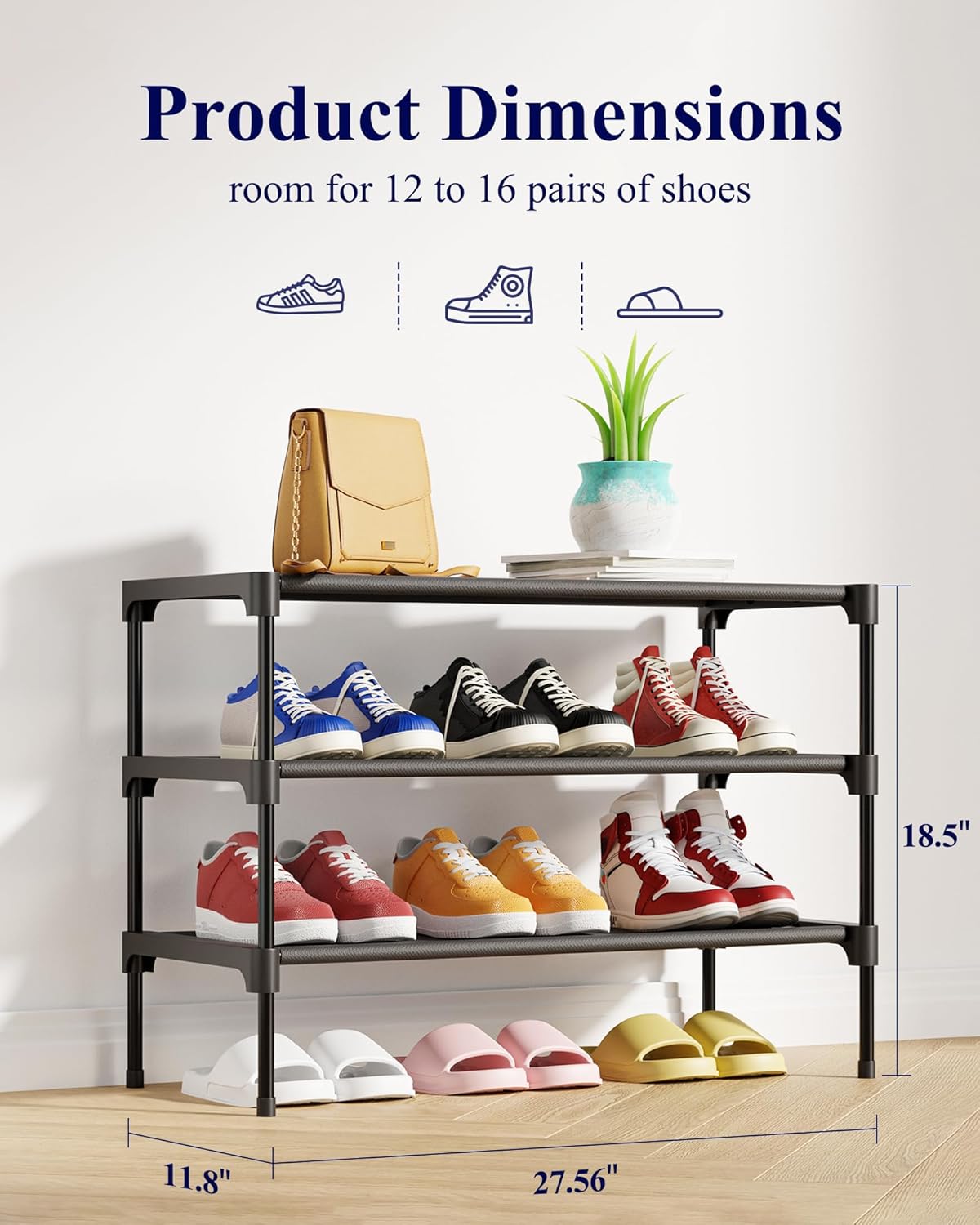
At 27.5 inches wide, the rack occupies a modest horizontal footprint. The depth and height are not explicitly listed in the description, but a three‑tier configuration typically yields a vertical height of roughly 36–42 inches (assuming ~12 inches per tier). This makes the unit tall enough to accommodate most shoe styles while still fitting comfortably inside standard closet doors or against a wall in a hallway or garage.
Storage Capacity and Organization
Tier Layout
Three evenly spaced shelves provide distinct zones for different footwear categories. The description highlights accommodation for sneakers, heels, and slippers, implying that each tier can hold a variety of shoe shapes and sizes. The open‑shelf design—no dividers or compartments—means users can arrange shoes side‑by‑side, heel‑to‑toe, or in any pattern that maximizes the available surface area.
Estimated Shoe Count
Although the exact capacity is not supplied, a rough estimate can be made. A typical adult shoe occupies roughly 10–12 inches of width when placed side‑by‑side. With a 27.5‑inch wide shelf, approximately two to three pairs can sit comfortably per tier, depending on shoe bulk. Consequently, the three‑tier rack could store anywhere from six to nine pairs of average‑sized shoes. Larger items such as boots or high‑top sneakers may reduce this number, while slippers or flats could increase it.
Dust Protection
The non‑woven fabric’s dust‑blocking characteristic is a notable functional benefit. By preventing particulate matter from falling between shelves, the rack helps keep footwear cleaner over time, reducing the frequency of cleaning or polishing required.
Assembly and Setup
Tool‑Free Construction
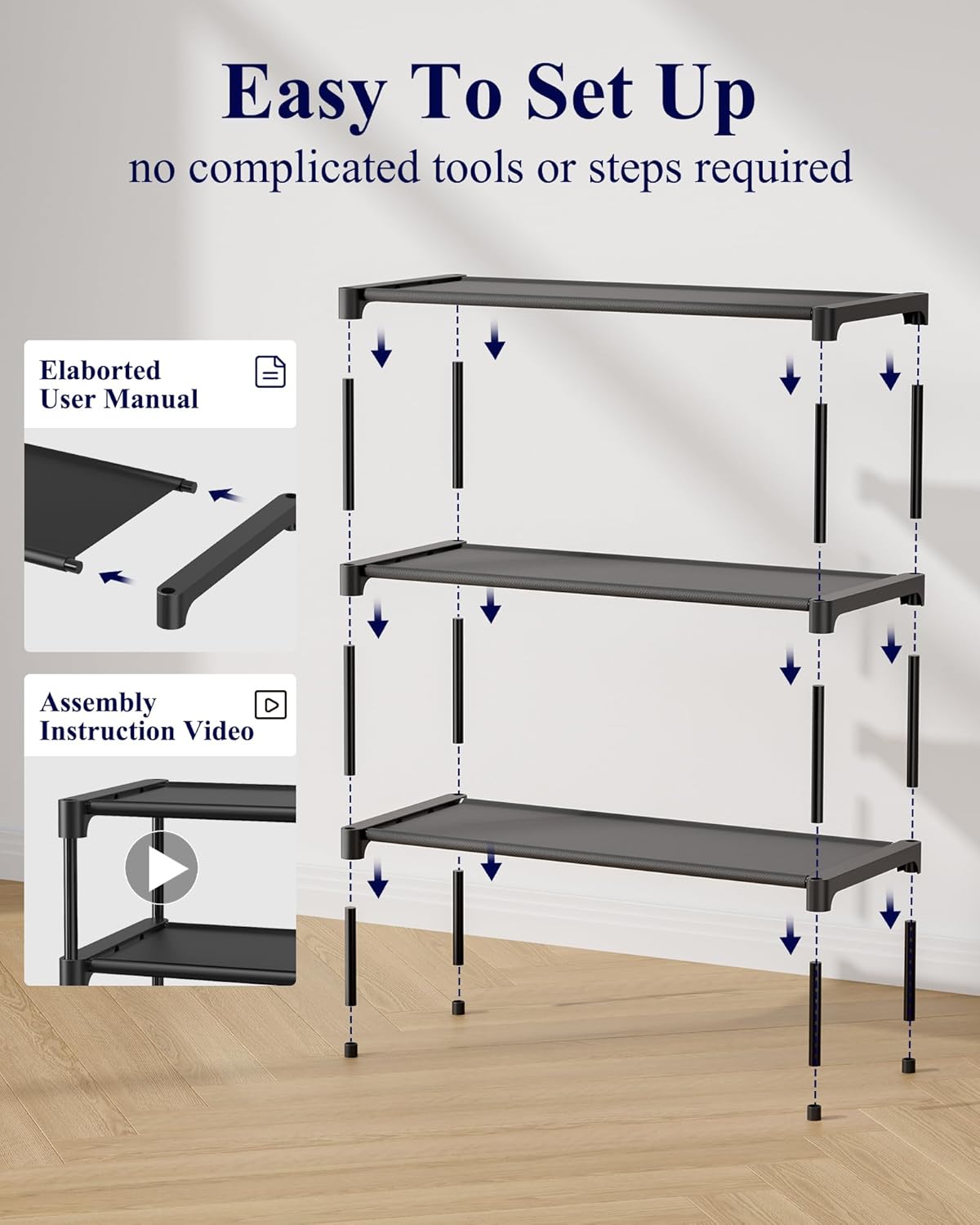
Kitsure emphasizes a four‑step, tool‑free assembly process, supplemented by step‑by‑step instructions and an installation video. The reliance on snap‑fit plastic connectors and possibly interlocking metal tubes suggests that users can erect the rack in under ten minutes without needing a screwdriver, Allen key, or hammer. This feature is especially appealing for renters, dormitory residents, or anyone who prefers to avoid permanent fixtures.
Stackability
The design incorporates a stackable mechanism—likely a set of alignment posts or recessed slots on the top of each unit that correspond to receptacles on the bottom of another. This enables users to purchase additional racks and vertically stack them to create a taller storage column. Stackability expands the system’s scalability without requiring additional floor space, a valuable trait for growing shoe collections or multi‑purpose storage needs (bags, suitcases, etc.).
Stability Considerations
While the description does not mention anti‑tip hardware or wall‑anchoring options, the inherent weight of the metal frame combined with the low center of gravity of a three‑tier unit should provide reasonable stability on a flat surface. For stacked configurations, users may want to ensure the floor is level and consider placing the assembly against a wall for added security.
Versatility and Multi‑Purpose Use
Room‑Specific Applications
| Location | Potential Use | Reasoning |
|---|---|---|
| Closet | Primary shoe organizer; can also hold folded bags or accessories | Fits within standard closet width; open shelves allow easy visibility. |
| Entryway | Drop‑zone for daily wear shoes, keeping dirt off flooring | Near‑door placement benefits from dust‑blocking fabric; quick grab‑and‑go. |
| Garage | Storage for work boots, sports cleats, or seasonal footwear | Metal frame tolerates temperature variations; fabric shields shoes from garage dust. |
| Corridor/Hallway | Decorative yet functional shoe line‑up in narrow spaces | Slim profile suits tight hallways; black finish adds a modern touch. |
| Living Room / Bedroom | Temporary staging for shoes before outings or after workouts | Portable nature allows relocation as needed. |
The product’s “compact size” and “free‑standing” nature reinforce its suitability for environments where built‑in shelving is unavailable or undesirable. Moreover, the ability to repurpose the shelves for items beyond shoes—such as handbags, backpacks, or folded blankets—extends its utility beyond a single‑function organizer.
Durability and Maintenance
Material Longevity
Metal tubes, especially when powder‑coated or treated for corrosion resistance, tend to endure daily use without bending or rusting. The plastic connectors, if made from high‑impact polypropylene or similar, should resist cracking under normal load. The non‑woven fabric, while not as abrasion‑resistant as canvas or polyester, is generally resilient to light wear and can be spot‑cleaned with a damp cloth. Because the fabric is removable (implied by the “shelf” description), users could potentially replace it if it becomes stained or worn.
Cleaning Procedure
Maintenance appears straightforward: wipe the metal and plastic components with a mild detergent solution, and gently vacuum or brush the fabric shelves to remove surface dust. The dust‑blocking quality of the fabric means that less frequent deep cleaning may be required compared with open wire racks.
Load Limits
Though explicit weight limits are not disclosed, the combination of metal tubing and a relatively broad shelf suggests a safe load of at least 20–25 lb per tier—sufficient for multiple pairs of shoes, a handbag, or a small suitcase. Users should avoid concentrating excessively heavy items (e.g., large boxes of books) on a single shelf to prevent undue stress on the connectors.
Advantages (Inferred from Specification)
- Ease of Assembly – Tool‑free, video‑guided setup reduces barriers for novice users.
- Modular Scalability – Stackable design permits vertical expansion without sacrificing floor area.
- Dust‑Resistant Shelves – Non‑woven fabric protects shoes and minimizes cleaning frequency.
- Neutral Aesthetic – Black finish blends with varied décor schemes, avoiding visual clutter.
- Multi‑Environment Suitability – Suitable for closet, entryway, garage, hallway, and other spaces.
- Lightweight Yet Sturdy – Metal frame offers strength while keeping the unit portable for repositioning.
Potential Limitations (Inferred from Specification)
- Open Shelf Design – Lack of dividers or lips may allow smaller shoes to shift or slide off if not arranged carefully.
- No Explicit Weight Rating – Users must gauge load tolerance based on feel; overloading could strain plastic joints.
- Fabric Wear Over Time – Non‑woven material may pill or fray with heavy abrasion, necessitating eventual replacement.
- Limited Height Customization – While stackable, the fixed tier spacing may not accommodate unusually tall boots without adjusting the arrangement (e.g., placing them diagonally).
- No Mention of Anti‑Tip Features – For tall stacks, additional stabilization (wall brackets or a wider base) might be advisable in high‑traffic areas.
Ideal User Profile
The Kitsure shoe rack appears best suited for individuals or households that:
- Require a quick‑to‑install, non‑permanent storage solution (renters, college students, temporary living arrangements).
- Have moderate shoe collections (approximately six to twelve pairs) and desire visible, accessible storage.
- Value a clean, modern look that can transition between different rooms without clashing with existing décor.
- Appreciate the flexibility to expand storage vertically as needs evolve, without purchasing an entirely new unit.
- Prefer a low‑maintenance organizer that shields shoes from dust and minor scuffs.
Conversely, users with extensive shoe inventories (over twenty pairs), those needing specialized compartments for boots or shoe care products, or anyone seeking a heavy‑duty, industrial‑grade rack may need to consider alternatives with higher load capacities or more rigid shelving.
Final Verdict
Based solely on the product’s title and supplied description, the Kitsure Shoe Rack emerges as a well‑considered, functional option for everyday shoe storage in a variety of residential settings. Its strengths lie in the simplicity of assembly, the protective nature of the non‑woven fabric shelves, and the stackable, modular architecture that enables users to tailor the system to their spatial constraints. While certain aspects—such as the absence of explicit weight limits, potential shelf wear, and the open‑shelf layout—warrant cautious use, these do not outweigh the clear benefits for the target audience seeking an affordable, adaptable, and tidy solution to shoe clutter.
In sum, the Kitsure shoe rack delivers on its promise of spacious, easy‑to‑set‑up organization that can migrate from closet to entryway to garage with minimal effort. For those in search of a reliable, no‑fuss shoe organizer that balances form and function, this model warrants serious consideration.