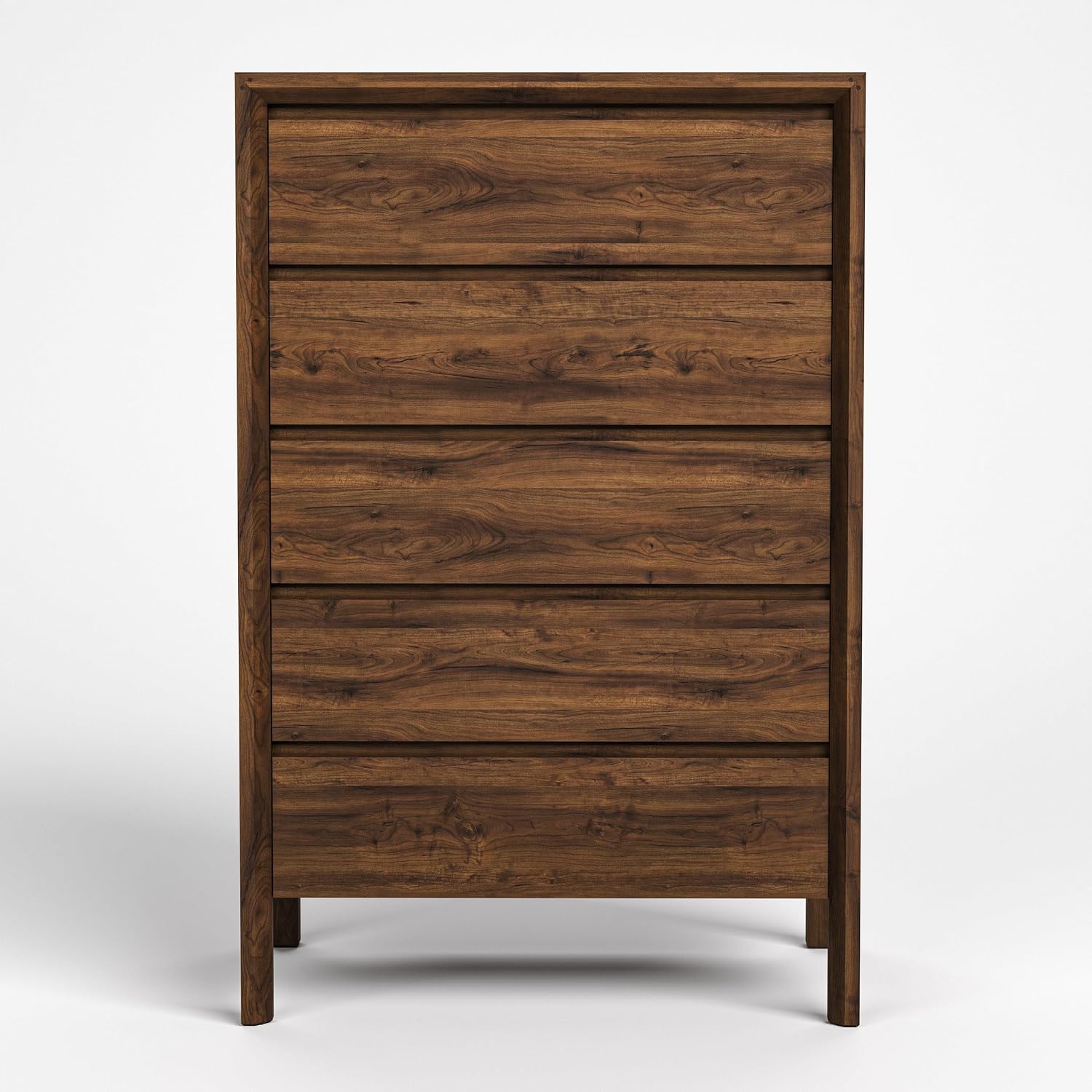
Stickley Saranac Tall Chest, Dresser, Solid Rustic Walnut, Sustainable Construction, 5 Drawers, Finger Pulls, 33in W x 20in D x 51in H, Made in USA


Price: $2,824.00
(as of Jun 22, 2026 12:20:46 UTC – Details)

The Stickley Saranac Tall Chest: A Study in Sustainable Craftsmanship and Enduring Design
In an era often dominated by mass-produced furnishings, the Stickley Saranac Tall Chest stands as a deliberate counterpoint – a piece where material honesty, time-tested construction methods, and a deep respect for resourcefulness converge. Far from being merely a storage solution, this 33-inch wide, 20-inch deep, and 51-inch tall chest embodies a philosophy: that true quality resides in the integrity of its making, the story of its materials, and the quiet functionality of its design. Based solely on the manufacturer’s detailed description, we can unpack the specific attributes that define this piece within Stickley’s legacy.
The foundation of the Saranac Tall Chest’s appeal begins unmistakably with its material story. Crafted from what the description identifies as “rustic offcuts of black walnut,” this chest directly addresses a critical aspect of modern furniture production: waste reduction. Instead of discarding sections of walnut log deemed imperfect for conventional grading – sections characterized by dramatic knots, surface checks (those natural, non-structural cracks that occur as wood dries), and striking swirls of light and dark grain – Stickley intentionally sources these very elements. This approach transforms what might be considered manufacturing byproduct into the chest’s defining aesthetic feature. The result is not uniformity, but a celebration of wood’s inherent variability. Each Saranac piece possesses a unique topography of grain and character, ensuring that no two chests are identical. This commitment to using offcuts isn’t merely a sustainability footnote; it’s the core of the collection’s visual identity, delivering a “modern rustic style” where the wood’s natural drama takes center stage, unobscured by excessive ornamentation.
This material philosophy is seamlessly integrated with construction techniques engineered for longevity, directly supporting the claim of drawers “built to last.” The chest employs mortise-and-tenon joinery at its primary frame connections – a hallmark of fine woodworking where a projecting tenon on one piece fits snugly into a corresponding mortise (hole) in another, creating an exceptionally strong mechanical bond resistant to racking and stress over decades. Complementing this, the description notes “splined corners.” Splines – thin strips of wood fitted into grooves cut across the joint – add significant reinforcement, particularly to corner joints susceptible to separation, while also offering a subtle visual detail that speaks to meticulous craftsmanship. These traditional methods, far from being archaic, are proven strategies for creating furniture capable of enduring generations of use, a stark contrast to reliance on modern adhesives or mechanical fasteners alone that may degrade or fail over time.
The true test of a chest’s quality, however, often lies in its drawers – the components subjected to daily, repetitive stress. Here, the Saranac Tall Chest exhibits particular attention to detail. Each of the five drawers is described as “side-hung and center-guided.” Side-hung suspension, where the drawer is supported by runners attached to its sides, is a robust system that distributes weight effectively. Center-guiding, typically involving a central rail or mechanism that keeps the drawer aligned as it opens and closes, prevents binding and ensures smooth, stable motion – a critical factor in avoiding the frustrating drawer that sticks or tilts. Crucially, the drawer boxes themselves feature dovetail construction. Dovetails, with their interlocking wedge-shaped pins and tails, provide exceptional tensile strength to resist the pulling forces exerted when a drawer is opened, preventing the front from separating from the sides. This is a hallmark of drawer construction designed for a lifetime of use. The combination of side-hung, center-guided suspension with dovetailed boxes creates a system where smooth motion and structural integrity are intrinsically linked.
Functionality is further enhanced by thoughtful details that serve practical purposes without compromising aesthetics. The replacement of traditional hardware with “finger pulls” is a significant design choice. These recessed grips, carved directly into the drawer fronts, eliminate protruding knobs or handles. This achieves a clean, uncluttered facade that emphasizes the continuity of the wood surface – vital for showcasing the rustic walnut’s character – while also reducing potential snag points on clothing or nearby furnishings. It speaks to a minimalist, casual elegance aligned with the collection’s “modern rustic” description. Equally practical is the inclusion of a “bottom dust panel.” This often-overlooked feature is a simple yet effective barrier, typically a thin sheet of wood or composite material fitted across the interior base of the chest, preventing dust, lint, or small debris from settling on stored clothing from below. It’s a small detail that significantly contributes to the chest’s effectiveness as a garment protector over time, demonstrating a holistic approach to storage utility.
The commitment to quality extends beyond the visible and functional elements to the very marks of origin. The chest bears Stickley’s “burned-in logo” and the “Als Ik Kan” shop mark. These are not mere decals; they are permanently applied symbols, burned into the wood surface, representing 125 years of the company’s dedication to craftsmanship. The Als Ik Kan motto (“I can if I try”) is a historic touchstone of Stickley’s ethos, signifying pride in skilled labor. Furthermore, the explicit statement that the Saranac Collection is “manufactured by skilled artisans at the Stickley factory in Manlius, New York and at Stickley Fine Upholstery in Archdale, North Carolina” anchors the chest in a specific, verifiable American manufacturing lineage. This “Made in USA” claim, backed by named facilities, reinforces the narrative of accountable, skilled production distinct from anonymous offshore assembly.
The synthesis of these elements creates a piece that feels both grounded and refined. The sustainable use of rustic walnut offcuts provides not only an environmental benefit – utilizing material that would otherwise enter the waste stream – but also generates the unique, visually rich surface that defines the Saranac aesthetic. This material honesty is matched by construction integrity: mortise-and-tenon frames, splined corners, side-hung center-guided drawers with dovetailed boxes, and finger pulls all serve clear functional purposes while contributing to an overall impression of solidity and considered design. The absence of heavy embellishment, relying instead on “deep bevels as the only embellishment” as noted in the description, allows the wood’s natural figure and the precision of the joinery to be the primary visual language. It is furniture where the process of making is visibly respected, and the material’s origin is honored rather than concealed.
Ultimately, the Stickley Saranac Tall Chest, as described, presents itself as more than a container for clothes. It is a tangible expression of specific values: a dedication to minimizing waste through intelligent material sourcing, an adherence to joinery methods proven by centuries of furniture making, a focus on the enduring utility of well-executed moving parts, and a confidence in American artisanal skill. It invites the owner to appreciate not just what the chest holds, but the story held within its very grain and joints – a story of sustainable practice, meticulous craft, and quiet, enduring quality designed to serve faithfully for years to come. In a market saturated with transient trends, the Saranac Tall Chest offers a compelling alternative: a piece built to be lived with, appreciated for its authenticity, and potentially passed on, embodying the very essence of timeless craftsmanship. (998 words)